
How to Propagate Pothos in Water or Potting Mix
Start with a healthy stem and a node. This guide shows where to cut, how water and potting-mix propagation differ, and when a cutting is ready for its own pot.
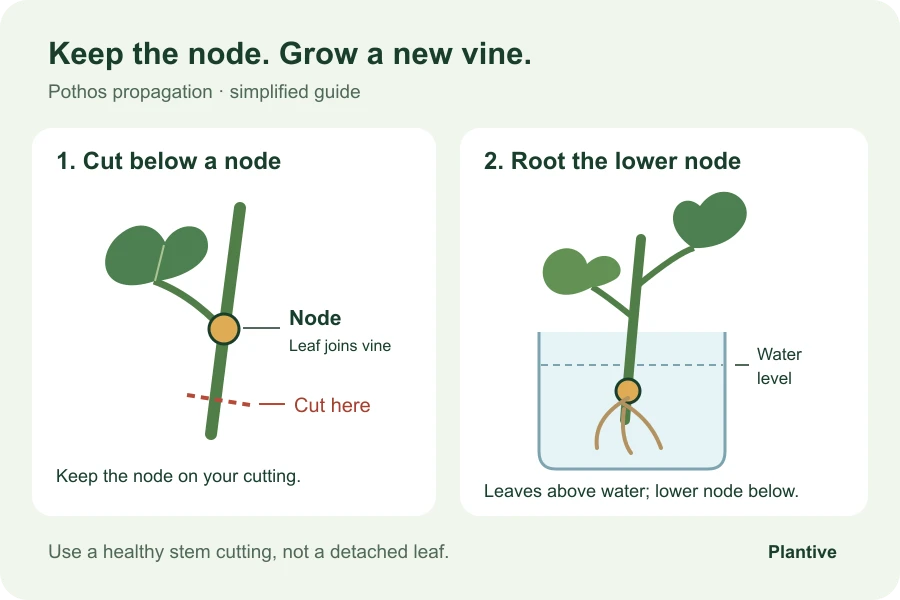
To propagate pothos, cut a healthy vine just below a node, remove the lowest leaf, and root that node in water or a moist, airy rooting medium. Keep the remaining leaves above the water or mix. Once roots have developed, move the cutting into a small pot with drainage.
This guide is for Epipremnum aureum, including golden and marble queen pothos. Check the pothos care guide if you are unsure of the plant’s identity. Pothos sap can irritate skin, and the plant should be kept away from children and pets that might chew it, as Wisconsin Extension explains.
Find the node before you cut
A node is the joint on the main vine where a leaf attaches. You may also see a small aerial-root nub nearby. The leaf stalk connects the leaf to this joint; cutting only that stalk leaves out the part of the vine you need.
Use clean, sharp scissors. Take a short stem section with a couple of leaves and at least one node that can sit below the water or mix. Make the bottom cut below that node, leaving it intact. Remove the lowest leaf if it would be submerged.
South Dakota State Extension explains why short cuttings are useful: a long, leafy vine can lose too much water before it develops roots. Do not strip most of the parent plant just to fill a jar.
Start with a healthy parent plant
Look for firm stems and healthy growth. Inspect leaf undersides and joints for mealybugs or other pests before taking cuttings.
Iowa State recommends propagating vigorous, healthy plants. Spring through summer is generally easiest, although indoor propagation can work at other times when conditions support growth. A cold windowsill in winter is a poor starting place.
Set out your container and rooting material before cutting so the stem does not sit drying on a counter.
Rooting pothos in water
- Use a clean jar with enough water to cover the lower node.
- Keep leaves clear of the water. Use a narrower container if the cutting keeps slipping down.
- Place it in a warm position with bright, indirect light.
- Refresh the water once or twice a week, and maintain the level around developing roots.
- Pot the cutting when it has usable roots around an inch long, rather than waiting for a tangled mass.
Those water-change and transplant guidelines come from Iowa State’s stem-cutting instructions. Water roots can be damaged during transplanting, so handle them gently.
Rooting directly in a growing medium
Use a clean container with drainage and a fresh, airy propagation medium, such as perlite mixed with peat or a prepared cutting mix. Moisten it first; it should not be dripping wet.
Make a hole, insert the lower node, and lightly settle the medium around the stem. Leave the leaves above the surface. Keep the medium moist while roots form, with warmth and indirect light. South Dakota State’s guide describes this method and the advantage of roots developing in a medium from the start.
| Choose water when… | Choose a rooting medium when… |
|---|---|
| You want to watch the roots develop | You prefer to start roots in an airy solid medium |
| You can refresh water regularly | You can check moisture without keeping it saturated |
| You are comfortable transplanting fragile roots | You have a clean draining container ready |
Moving rooted cuttings into a pot
Choose a pot that fits the small root system; a large decorative planter holds unnecessary wet mix. Several rooted cuttings can share one pot for a fuller plant, a practice recommended by Wisconsin Extension.
Set the roots into fresh potting mix, water to settle it and let excess water drain. Keep conditions steady and the mix from drying out completely during establishment. As growth resumes, transition to the usual pothos watering routine. Our repotting guide covers container choices.
When a cutting is not rooting
Use this check before changing everything at once:
| What you notice | What to check next |
|---|---|
| A leaf in water, but no piece of main vine | Start again with a stem node |
| A firm cutting with slow progress | Check warmth and light; photograph it weekly to compare |
| A node above the waterline | Restore the water level around the node |
| A soft, collapsing stem | Discard that cutting and clean the container before restarting |
| Wilting after potting | Check moisture and drainage before adding more water |
Keep a simple note of the cutting date, method and root development. It makes the next attempt easier to judge than a promised rooting date.
Sources and further reading
- Propagating Houseplants — Iowa State University Extension and Outreach
- How to Propagate Houseplants by Stem Tip Cuttings — Iowa State University Extension and Outreach
- Propagating Houseplants — South Dakota State University Extension
- Pothos, Epipremmum aureum — University of Wisconsin–Madison Extension
Frequently asked questions
Can I propagate pothos from a leaf without a node?
For normal home propagation, use a piece of the main vine with a node and bud. A detached leaf and its stalk are not a substitute for a stem cutting that can produce a new vine.
How long does pothos take to root?
Wisconsin Extension gives roughly three to four weeks in warm conditions. Treat that as an estimate: temperature, light and the condition of the cutting affect progress. Check for firm new roots rather than relying on a deadline.
Is water or soil better for pothos propagation?
Both can work. Water lets you see roots develop; a moist, airy rooting medium avoids a later change from water to potting mix. Choose the method you can check regularly.
More from the blog
Grow Lights for Houseplants: Distance, Timing and Setup
A useful grow light needs to reach the leaves for enough of the day. Learn how to choose a setup, set its distance and timer, and judge the plant’s response.
IdentificationHow to Identify Plants on iPhone: Visual Look Up and Apps
Your iPhone can already name many plants from a photo. Here is how to use Visual Look Up, when to try Google Lens or a plant app instead, and how to check the answer.
App comparisonsPlant Identification Apps Compared: Plantive and Alternatives
A source-linked comparison of five plant identification and care apps, including what each listing offers and what the listings cannot prove.